Hey, what's up?? My name is Alexis, but i prefer Lex. I am a junior Mass Communications major at South Carolina State University. I'm from Fairfield, SC. When i graduate, i plan to pursue a career in Public Relations. My interests include: music, singing, dancing, reading, taking pictures, fashion, writing and etc.
Thursday, January 14, 2016

Sunday, December 6, 2015
" Bulldog Walk" Fashion Show
In class, we were teamed up into groups to do a little project in the TV studio. We were to do something like an interview or anything of that sort. My team decided to do a fashion show instead. My team was composed of: Kyre Cox, Deliah Stroman, Mufasa Shaw, Ericka Moore, and myself. Ericka and I were in the control booth creating the wonderful show!
Chapter 7 Discussion Questions
1. Explain the essential role of the interview in video stories.
To gather facts, but an equivalent obligation is to reveal the person being interviewed.
2. Discuss ways that will help you establish trust with an interview source.
A brief chat over coffee, but it can never happen unless you have a genuine interest in people and have the self-confidence to reveal something of yourself. If you are afraid to approach people as you launch your interviewing career, remember that most people feel flattered to be on TV even if they seem nervous at first.
3. What personal conduct and manners are important to observe whenever you are in someone else's home or office?
Arrive on time and take leave before you wear out your welcome. Leave the chewing gum at home, and refrain from sitting unless you are invited. Be friendly, but not overly familiar.
5. Discuss ways to help put the interview at ease.
Interviewees are more at ease if they can focus on familiar work and surroundings than if they are forced to focus on themselves, their appearance, or their performance during the interview. Often you can interview people while they're engaged in familiar activities rather than standing them in front of a blank wall and thrusting a stick mike in their face.
6. Why is it important not to reveal the questions you intend to ask until the actual interview begins?
To help preserve the feeling of spontaneity, try not to share questions in advance of the interview. That's because subjects ordinarily put most of their energy into their first response. Once the camera rolls they may leave out the details because having told you once, they assume you already know what they said.
8. Explain why research and planning are so important to the interview process.
The more you know about your source, the more confidence you give the person and the more you can concentrate on listening without having to worry about the next question you'll ask. Anyone can ask anyone else's questions, but the interviewer can succeed only by asking informed questions that are based on knowing everything possible about the subject.
11. What constitutes a "dumb" interview question?
"How do you feel?" The question is asked of grieving parents, air crash survivors, and losers of football games. Perhaps the question is inappropriate because the answer normally is so obvious "I feel like hell/sad/miserable/alone/scared/angry."
To gather facts, but an equivalent obligation is to reveal the person being interviewed.
2. Discuss ways that will help you establish trust with an interview source.
A brief chat over coffee, but it can never happen unless you have a genuine interest in people and have the self-confidence to reveal something of yourself. If you are afraid to approach people as you launch your interviewing career, remember that most people feel flattered to be on TV even if they seem nervous at first.
3. What personal conduct and manners are important to observe whenever you are in someone else's home or office?
Arrive on time and take leave before you wear out your welcome. Leave the chewing gum at home, and refrain from sitting unless you are invited. Be friendly, but not overly familiar.
5. Discuss ways to help put the interview at ease.
Interviewees are more at ease if they can focus on familiar work and surroundings than if they are forced to focus on themselves, their appearance, or their performance during the interview. Often you can interview people while they're engaged in familiar activities rather than standing them in front of a blank wall and thrusting a stick mike in their face.
6. Why is it important not to reveal the questions you intend to ask until the actual interview begins?
To help preserve the feeling of spontaneity, try not to share questions in advance of the interview. That's because subjects ordinarily put most of their energy into their first response. Once the camera rolls they may leave out the details because having told you once, they assume you already know what they said.
8. Explain why research and planning are so important to the interview process.
The more you know about your source, the more confidence you give the person and the more you can concentrate on listening without having to worry about the next question you'll ask. Anyone can ask anyone else's questions, but the interviewer can succeed only by asking informed questions that are based on knowing everything possible about the subject.
11. What constitutes a "dumb" interview question?
"How do you feel?" The question is asked of grieving parents, air crash survivors, and losers of football games. Perhaps the question is inappropriate because the answer normally is so obvious "I feel like hell/sad/miserable/alone/scared/angry."
Thursday, November 5, 2015
Chapter 6 Discussion Questions
1. Of the various microphones, which types are most frequently used to cover news and field events? Compare the strengths and weaknesses of each type.
Hand mike, lavaliere mike, and shotgun mike. Handheld strengths are it looks good on the camera with the logo, weakness is that you have to hold it. Lavaliere mike strength is that it is attached to your clothing and it's hidden, weakness is that it can disconnect. Shotgun mike strength is that it is long enough to be able to get close enough to your subject, weakness is that it is big and bulky.
4. Discuss the typical uses of the handheld, lavaliere, and shotgun microphones in news applications.
The handheld mic is often used for its bulletproof construction and for how they look wearing a mike flag, the little box around with the station logo around the mic. The lavaliere is often used for interviews because it is more appropriate since it is easily hidden. The shotgun mic is used in situations where you can't get close enough to the speaker.
6. When you work with news subjects, what considerations are most important to remember in concealing the miniature microphone beneath their clothing or in other personal effects?
Lavs usually sound good mounted at about sternum height; a mike mounted too high on the neck may sound muffled, with the chin blocking some sound; a mike mounted too low may sound thin and distant. If necessary, tape the mike firmly to the shirt or body to keep it from producing extraneous noise when the person moves.
7. Overall, what are the most important considerations to follow if you are to achieve good-quality sound in the field?
Achieving good sound is a matter of learning to listen for sound and to differentiate between what is acceptable and what is not. Listen to sound recordings for hiss, buzz, boomy, sound, low, volume, and distortion. Eliminate them if you hear it in your recording.
8. Explain why it is essential for the photojournalist or soundperson to constantly monitor sound in the field with earphones.
There's no other way to determine whether the sound is good enough unless you monitor it with earphones. If you can't hear it, then you won't know what's wrong.
9. Discuss the full range of techniques you can use to reduce wind noise in the field.
You can use open-celled acoustic foam. It has holes that allows the wind to pass through it. A microphone in a large mesh cage called a zeppelin is used when it's windy. You also need a filter, it sharply attenuates low frequencies and allows the highs to pass through.
13. Explain the role of nat sound in helping lend a sense of realism to television news stories.
Nat sound is a storytelling tool. All sound other than speech that occurs naturally in our environment is an expression of our desire for realism. When we hear sounds on television that imitate or draw from our own life experiences, we bring the story to a more profound and intimate depth of understanding.
Hand mike, lavaliere mike, and shotgun mike. Handheld strengths are it looks good on the camera with the logo, weakness is that you have to hold it. Lavaliere mike strength is that it is attached to your clothing and it's hidden, weakness is that it can disconnect. Shotgun mike strength is that it is long enough to be able to get close enough to your subject, weakness is that it is big and bulky.
4. Discuss the typical uses of the handheld, lavaliere, and shotgun microphones in news applications.
The handheld mic is often used for its bulletproof construction and for how they look wearing a mike flag, the little box around with the station logo around the mic. The lavaliere is often used for interviews because it is more appropriate since it is easily hidden. The shotgun mic is used in situations where you can't get close enough to the speaker.
6. When you work with news subjects, what considerations are most important to remember in concealing the miniature microphone beneath their clothing or in other personal effects?
Lavs usually sound good mounted at about sternum height; a mike mounted too high on the neck may sound muffled, with the chin blocking some sound; a mike mounted too low may sound thin and distant. If necessary, tape the mike firmly to the shirt or body to keep it from producing extraneous noise when the person moves.
7. Overall, what are the most important considerations to follow if you are to achieve good-quality sound in the field?
Achieving good sound is a matter of learning to listen for sound and to differentiate between what is acceptable and what is not. Listen to sound recordings for hiss, buzz, boomy, sound, low, volume, and distortion. Eliminate them if you hear it in your recording.
8. Explain why it is essential for the photojournalist or soundperson to constantly monitor sound in the field with earphones.
There's no other way to determine whether the sound is good enough unless you monitor it with earphones. If you can't hear it, then you won't know what's wrong.
9. Discuss the full range of techniques you can use to reduce wind noise in the field.
You can use open-celled acoustic foam. It has holes that allows the wind to pass through it. A microphone in a large mesh cage called a zeppelin is used when it's windy. You also need a filter, it sharply attenuates low frequencies and allows the highs to pass through.
13. Explain the role of nat sound in helping lend a sense of realism to television news stories.
Nat sound is a storytelling tool. All sound other than speech that occurs naturally in our environment is an expression of our desire for realism. When we hear sounds on television that imitate or draw from our own life experiences, we bring the story to a more profound and intimate depth of understanding.
Sunday, October 25, 2015
Chapter 5 Discussion Questions
2. What is color temperature and how does it affect the video image?
An expression of the proportion of red to blue light source radiates.
6. Describe the differing roles of the key light and the fill light.
The key light illuminates the scene and the fill lights fills in the dark shadows.
7. Describe the basic lighting patterns commonly used when shooting video.
The most frequent pattern is one dominant light source the sun or an artificial light combined with a secondary light source. The dominant source produces direct light rays that throw strong highlights and distinct shadows in an effect called specular light.
11. What minimum lighting equipment should the photojournalist have available for field assignments?
Two focusing quartz lights, one focusing mini light, and one folding fabric reflector.
13. Explain how to light a news conference or similar gathering.
Key, fill, and backlight to bring the subject out of the background.
15. What safety precautions should you observe anytime you work with lights?
When you plug in the lights, try to tilt them down to the floor, then swing them up the light heads gently so as not to blind your subjects suddenly. Another approach is to use your hand to block the light when it is first switched on, then slowly lower your hand from the light head to permit gradual, full illumination of your subject.
An expression of the proportion of red to blue light source radiates.
6. Describe the differing roles of the key light and the fill light.
The key light illuminates the scene and the fill lights fills in the dark shadows.
7. Describe the basic lighting patterns commonly used when shooting video.
The most frequent pattern is one dominant light source the sun or an artificial light combined with a secondary light source. The dominant source produces direct light rays that throw strong highlights and distinct shadows in an effect called specular light.
11. What minimum lighting equipment should the photojournalist have available for field assignments?
Two focusing quartz lights, one focusing mini light, and one folding fabric reflector.
13. Explain how to light a news conference or similar gathering.
Key, fill, and backlight to bring the subject out of the background.
15. What safety precautions should you observe anytime you work with lights?
When you plug in the lights, try to tilt them down to the floor, then swing them up the light heads gently so as not to blind your subjects suddenly. Another approach is to use your hand to block the light when it is first switched on, then slowly lower your hand from the light head to permit gradual, full illumination of your subject.
Thursday, October 22, 2015
Wednesday Class Activity
In Wednesday's class, we discussed recording someone and how to get the proper lighting when outside. Our teacher showed us two shots he took; one with the sun in the shot and the other with perfect light. He explained to us about the usage of light reflectors you simply hold it up to reflect the sun out of your face to create a great shot.
We went outside by the Bank of America ATM on campus to try out the activity on our own. We used the reflectors to take either selfies or get a classmate to take a picture of us with and without the reflector. We also had to get a shot of us taking the selfie using the reflector, meaning someone else had to take that picture.
Here are my examples
Sun in

Sun out

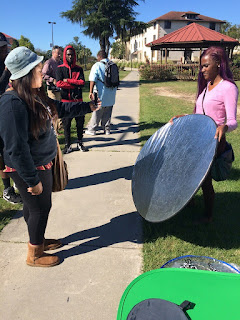
We went outside by the Bank of America ATM on campus to try out the activity on our own. We used the reflectors to take either selfies or get a classmate to take a picture of us with and without the reflector. We also had to get a shot of us taking the selfie using the reflector, meaning someone else had to take that picture.
Here are my examples
Sun in
Sun out
Overall view
Three Point Lighting Class Activity
We went over to the studio to do the activity. The task was to take a picture without any of the three lightings, then one with the key light only, then add the fill light, and then the back light so that we could see for ourselves how the light makes a difference.
Here are my pictures.
No light

Key light


Subscribe to:
Posts (Atom)